| |
|
|
"Quality data remains your key to AI"
- Tammy Bilitzky, Chief Information Officer, DCL |
|
|
|
NEWSLETTER | October 2026 STRUCTURING DATA AND CONTENT SINCE 1981
|
|
|
|
|
|
|
|
|
|
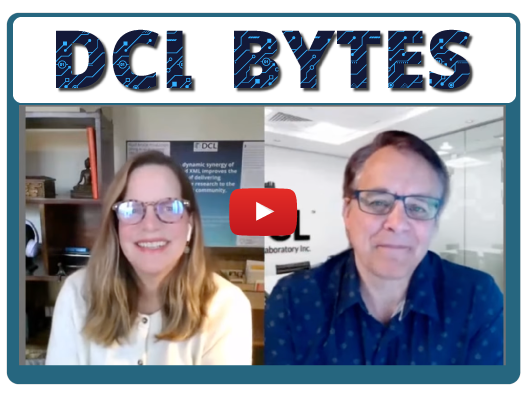
The blue sapphire is typically used to designate a 45th anniversary. Sapphires symbolize enduring strength, with their hardness measuring a 9 on the Mohs hardness scale, which is just behind diamonds at 10. This gemstone represents the attributes DCL strives to embody: wisdom, sincerity, trust, and loyalty. Mark Gross is the visionary behind the company and has been the president since day one. He recently reflected on DCL's history, the company's first projects, the challenges of early technology, and how DCL adapted to the digital age. Be sure to watch the until the end of the interview when Mark reflects on what 45 years means to him.
|
|
|
|
|
|
Is Your Metadata Sharing Too Much? |
Every file you share, post, and publish carries a second, invisible layer of information that you may overlook. When you hit send on a file or post a file to your organization's SharePoint or CMS, metadata travels with it, including who made it, when, with what software, and sometimes a geographic location. In this blog post we break down the types of metadata in three common applications and detail what kind of information you may inadvertently be sharing that you probably would prefer not to. |
|
|
|
|
|
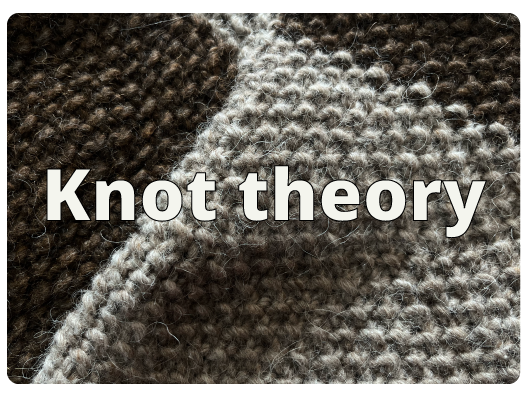
There's a Physics to Knitting? Really? |
Knot theory is the mathematical study of tangled curves. Fabricating a textile, let's say a scarf, involves entangling yarn into a pattern and essentially forming a large knot. Every knitter, or anyone who wears a knitted fabric, knows the heartbreak of dropping a stitch or tearing the yarn. Daisuke S. Shimamoto, a research postdoc in physics, along with his grandmother and research colleagues, has unraveled the topology of knitted fabrics and employed the mathematics of knot theory to devise a knit stitch that will not unravel when a stitch is dropped or the yarn is cut. |
|
|
|
|
|
Ten Priorities for Scholarly Publishing |
Darrell W. Gunter, President and CEO of Gunter Media Group, shares his wishes for publishers, societies, librarians, researchers, funders, and technology partners as we prepare for 2027. Darrell has spent his career thinking deeply about scholarly communications and how humanity is advanced by advancing quality research. He recently sat down with Research Information to share his top 10 list of actions with which the collective industry can improve together as we move toward the new year. |
|
|
|
|
|
DCL Bytes - Harmonizer Throws You a Lifeline With Knowledge Management |
|
|
|
|
|
|
|
|
|
|
|
DCL partners with many global organizations that complement our services and offer a complete workflow solution to our customers. Following are some recent highlights from DCL's Partnership Laboratory. |
|
|
|
The New Era of Pharmaceutical Documentation What if you could position your documentation as a competitive advantage? Built specifically for pharma/life sciences, Docuvera harnesses AI and structured content to provide a single platform to author, review, approve, translate, and publish regulated documents by reusing approved, component-based content — with reported productivity gains of up to 50% and 80% content reuse. This introductory short shows you how you can transform cumbersome content management into a streamlined process that helps you get to market faster. |
|
|
|
|
|
NEW BOOK: The Uninvited Author
Ready to make AI work for your content, instead of the other way around? The Uninvited Author is the guide you need. The Uninvited Author: AI, Intent, and the Future of Content is a new book by Carlos Eviaand Scriptorium founder Sarah O’Keefe. It provides critical guidance for content operations in the age of artificial intelligence. AI changes the balance of power between authors and readers, and understanding this shift is the key to successful AI content initiatives. Tailored for executives, content professionals, and educators, The Uninvited Author is full of practical advice to build sustainable AI operating models.
[LEARN MORE] |
|
|
|
|
|
The DCL Timeline: From SGML to AI
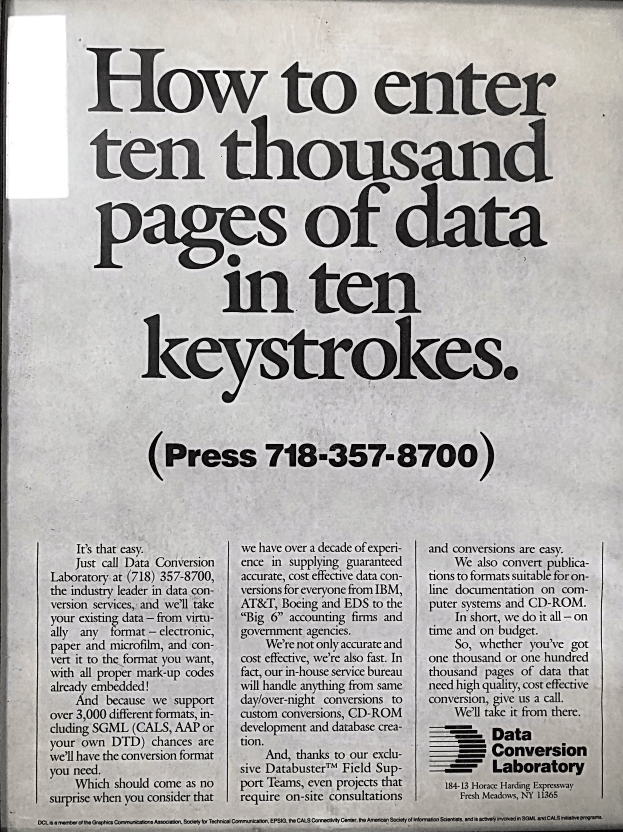
DCL has been structuring data and content since 1981. Key moments in DCL's history along with our own milestones take place alongside moments that shaped modern information technology. We've worked as SGML became an ISO standard, Tim Berners-Lee invented the World Wide Web, and the W3C published XML 1.0. Check out a 1987 New York Times feature, DCL's MindReader text-recognition tool, a methodology chapter in Charles Goldfarb’s XML Handbook, and the return of Wizzy the Owl. The DCL timeline is a reminder of how far content has come and of the thinking behind where it’s going next.
And this ad depicted here from The New York Times... that number still works!
[READ MORE] |
|
|
|
|
|
|
|
|
|
|
|
|