| |
|
|
"Quality data remains your key to AI"
- Tammy Bilitzky, Chief Information Officer, DCL |
|
|
|
NEWSLETTER | September 2026 STRUCTURING DATA AND CONTENT SINCE 1981
|
|
|
|
|
|
|
|
|
|
Scholarly Publications Ethics Monitor—An Automated System to Identify Ethical Violations During Peer Review |
Research integrity has moved to the forefront of the scholarly publishing conversation, as publishers and authors face scrutiny around the reliability, transparency, and trustworthiness of the scientific record. Citation coercion and fraudulent authorship are two forms of misconduct that manipulate the signals used to establish credibility in scholarly publishing. IEEE
partnered with DCL to develop the Publications Ethics Monitor solution to proactively detect citation coercion by monitoring occurrences of citation manipulation during peer review. The system tracks and scores changes that occur during editorial stages as well as the two to three manuscript revision cycles that a paper typically requires prior to acceptance. Click the link below to learn how this system supports IEEE's continued efforts to publish trusted research and science. |
|
|
|
|
|
What Do Music, Libraries, and Online Shopping Have in Common? And Does it Matter? |
Some taxonomy systems have inherent geographical and cultural bias that might not be recognized when viewing from the vantage point of the culture that built them. A taxonomy list may appear to be a universal and neutral categorical listing but it is not. AI-powered answer engines are exposing these hidden biases at scale. This blog post, by Scott Abel, The Content Wrangler, walks through case studies related to music classification, the Dewey Decimal System, and online shopping to expose how metadata and taxonomies are critical to findability and understanding in an increasingly AI-powered world.
|
|
|
|
|
|
For True Accessibility, Alt Text is Not Enough |
Alt text is an important part of making scholarly content accessible but it's only one piece of the puzzle. In this article by Jeff Lang, Founder and CEO at FigureTwo, makes the case for moving beyond accessibility checklists toward workflows where accessibility is built into content from the start. For publishers, that means thinking about the underlying structure and semantics. When content is properly structured, accessibility can be carried through XML, HTML, PDF, EPUB, and other outputs as part of the production process, helping to make content more usable for everyone. |
|
|
|
|
|
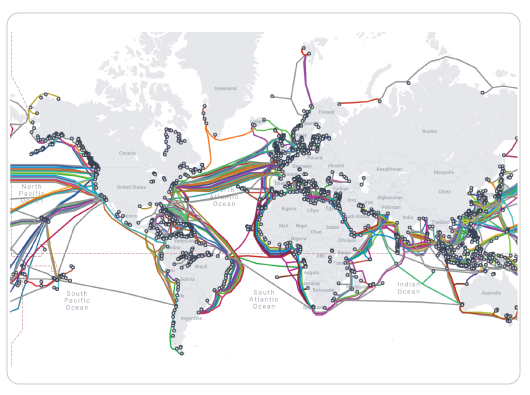
Even Our Very Digital World Depends on Physical Infrastructure |
TeleGeography is an independent, impartial research organization that collects and analyzes data across the telecommunications industry. TeleGeography's interactive Submarine Cable Map allows people to explore the fiber optic cable systems connecting countries and continents. This is a fascinating reminder that while our world is very much digital first, it absolutely relies on serious physical infrastructure that is hidden beneath our oceans. "Submarine Cable Map" by TeleGeography, used under CC BY-SA 4.0. Source: https://www.submarinecablemap.com |
|
|
|
DCL Bytes - The Conference That Wasn't: IEEE's Investigation into a Paper Mill Operation |
DCL Bytes is part of the DCL Learning Series and features short, informative clips on technology, structured content, and more. In this video short, Amanda Sulicz from IEEE details how she uncovered a serious paper mill operation while looking at a conference proceeding paper. Her investigative work ultimately led to the retraction of the entire conference's proceedings. |
|
|
|
|
|
|
|
|
|
|
|
DCL partners with many global organizations that complement our services and offer a complete workflow solution to our customers. Following are some recent highlights from DCL's Partnership Laboratory. |
|
|
|
Connecting Content, Planning, and Execution Workflows—No System Overhaul Required Airlines do not need another disconnected maintenance tool. They need a governed path from approved technical content to completed work. When authoring, publication, visit planning, work card preparation, technician access, and signoff occur across separate systems, teams waste time searching, reconciling updates, switching applications, and confirming whether instructions are current. Flatirons Fleet Edition connects Flatirons Knowledge Center with Flatirons Studio, Flatirons Pinpoint, Flatirons EMS (eTaskCard Management Service), and Flatirons eTaskcard. Each product has a defined role, and the handoffs between them create a coordinated content-to-execution workflow. Flatirons Knowledge Center, in conjunction with Flatirons Studio, is the governed source for authoring, managing, and publishing technical data and task card content.
|
|
|
|
|
|
AI and Good Science: A Discussion on Publishing with SAE
People's use of generative AI is on the increase. From emails sent to bosses, to ads in which people have six or more fingers, to songs charting the Billboard Top 100, AI end results can be seen in many use cases across multiple industries. At SAE®, we’ve even spotted an increase in journal and technical paper submissions from across the mobility industry that consist of large portions of or entirely AI-generated research papers. Many people seem to use gen-AI to offload creative, difficult, or otherwise time-consuming processes, but what does this mean in terms of reliability? Quite a lot, actually.
[READ MORE] |
|
|
|
|
|
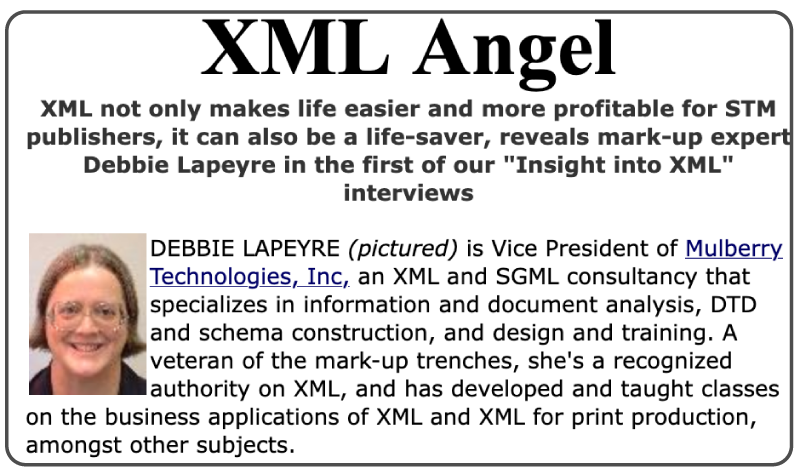
XML Angel: Debbie Lapeyre
In 2008, DCL launched a series in which key figures from the world of STM publishing were interviewed and asked why they should embrace XML. "XML Angel" Debbie Lapeyre, VP at Mulberry Technologies, was the first person interviewed for the series. Last month, the long-standing conference Balisage, produced by Mulberry Technologies, came to an end. We thought it was fitting to reread Debbie's interview and revisit the perspective of someone who was, and remains, an important voice of XML and scholarly publishing. [READ MORE] |
|
|
|
|
|
|
|
|
|
|
|
|